AI Assisted oncology

At Neovita Oncology, AI-Assisted Oncology represents the convergence of cutting-edge artificial intelligence technology with world-class clinical expertise, creating a revolutionary approach to cancer care that enhances every aspect of the patient journey. Our AI-powered platform transforms how we diagnose, treat, and monitor cancer, providing our clinical teams with unprecedented insights and predictive capabilities that translate directly into improved outcomes and personalized care experiences for our patients


AI Assisted Oncology

At Neovita Oncology, AI-Assisted Oncology represents the convergence of cutting-edge artificial intelligence technology with world-class clinical expertise, creating a revolutionary approach to cancer care that enhances every aspect of the patient journey. Our AI-powered platform transforms how we diagnose, treat, and monitor cancer, providing our clinical teams with unprecedented insights and predictive capabilities that translate directly into improved outcomes and personalized care experiences for our patients.

As a cornerstone of our comprehensive cancer care approach, AI-Assisted Oncology seamlessly integrates with our Radiation Oncology, CAR-T & Cellular Therapies, and Quantum/Computational Oncology programs to create a synergistic ecosystem of advanced treatment modalities. This integration ensures that every patient benefits from the collective power of artificial intelligence working in harmony with human expertise, clinical intuition, and compassionate care that defines the Neovita experience

Background History and Evolution The intersection of artificial intelligence and medicine began in the 1960s with early expert systems designed to assist in medical diagnosis, but the application of AI to oncology has undergone exponential acceleration in recent decades. The foundational work in medical AI can be traced to pioneers like Edward Feigenbaum and Joshua Lederberg, who developed DENDRAL in the 1960s, one of the first expert systems designed to solve scientific problems.

The 1970s and 1980s saw the development of early medical expert systems like MYCIN for infectious disease diagnosis and INTERNIST-I for internal medicine. However, these early systems were limited by computational power and the complexity of medical decision-making. The real breakthrough came with the advent of machine learning algorithms in the 1990s and the subsequent explosion of big data and computational power in the 2000s.

The Human Genome Project, completed in 2003, provided the foundational genomic data that would later fuel AI-driven precision medicine initiatives. The development of deep learning algorithms in the 2010s, particularly convolutional neural networks for image analysis, revolutionized medical imaging interpretation and opened new possibilities for AI applications in oncology.

IBM Watson for Oncology, launched in 2013, represented one of the first major commercial attempts to apply AI to cancer care, though it faced challenges in real-world implementation. More successful have been focused AI applications like Google’s LYNA (Lymph Node Assistant) for pathology image analysis, which demonstrated superhuman accuracy in detecting breast cancer metastases in lymph nodes.

The COVID-19 pandemic accelerated AI adoption in healthcare, with successful applications in drug discovery, diagnostic imaging, and treatment optimization. Today’s AI systems in oncology leverage advanced machine learning, deep learning, natural language processing, and computer vision technologies to address complex challenges across the entire cancer care continuum.


Insightful Knowledge and Clinical Perspectives AI-Assisted Oncology operates on several fundamental principles that distinguish it from traditional approaches to cancer care. The power of AI lies not in replacing clinical judgment but in augmenting human expertise with pattern recognition capabilities that exceed human cognitive limitations, particularly in processing vast amounts of complex, multidimensional data.

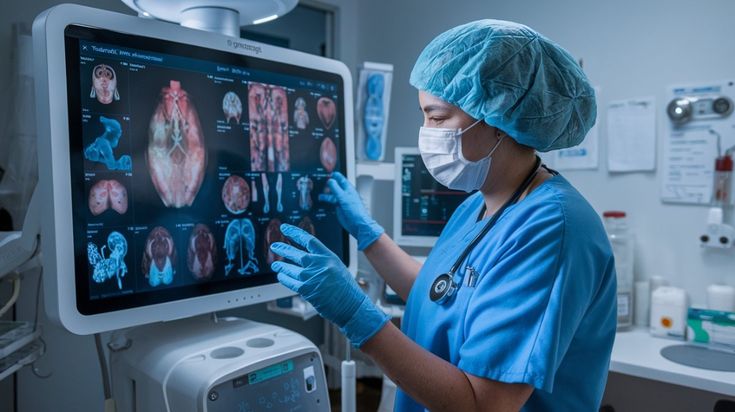
Pattern Recognition and Diagnostic Enhancement: Modern AI systems can analyze medical images with accuracy that often exceeds human radiologists, particularly in detecting subtle patterns indicative of early-stage cancers. Deep learning algorithms trained on millions of images can identify features invisible to the human eye, including texture patterns, pixel-level variations, and morphological characteristics that correlate with specific tumor types and molecular markers.

Predictive Modeling and Treatment Optimization: AI excels at integrating diverse data sources; genomic profiles, imaging data, clinical parameters, treatment history, and even social determinants of health; to create sophisticated predictive models. These models can forecast treatment response, predict toxicity patterns, and identify optimal treatment sequences with unprecedented accuracy.

Real-Time Adaptive Treatment: Advanced AI systems enable real-time treatment adaptation based on continuous monitoring of patient response. By analyzing biomarkers, imaging changes, and clinical parameters in real-time, AI can recommend treatment modifications before clinical deterioration becomes apparent, potentially improving outcomes and reducing toxicity.


Natural Language Processing: Advanced NLP systems can extract meaningful insights from unstructured clinical data, including physician notes, pathology reports, and research literature. This capability enables comprehensive analysis of patient histories and real-time integration of emerging research findings into clinical decision-making.

Federated Learning and Privacy Protection: Modern AI systems employ federated learning techniques that enable collaborative model training across multiple institutions while preserving patient privacy. This approach allows AI systems to benefit from vast datasets without compromising individual patient confidentiality.

How Neovita Triumphs in AI-Assisted Oncology Neovita Oncology has established itself as a pioneer in AI-Assisted Oncology through our comprehensive approach that combines state-of-the-art technology with deep clinical expertise and unwavering commitment to patient-centered care. Our AI platform represents years of development, clinical validation, and continuous refinement that places us at the forefront of this rapidly evolving field.

Proprietary AI Platform Integration: Our AI-Assisted Oncology platform seamlessly integrates with all aspects of cancer care at Neovita, from initial diagnosis through survivorship. This integration extends across our Radiation Oncology treatment planning systems, our Personalised Vaccines development protocols, and our Clinical Trials Access patient matching algorithms. The platform continuously learns from every patient interaction, treatment response, and outcome, creating an ever-improving system that benefits all future patients.


Advanced Imaging and Diagnostic AI: Our AI imaging systems employ multiple deep learning architectures trained on vast datasets of oncologic imaging studies. These systems provide real-time analysis of CT, MRI, PET, and pathology images, offering diagnostic insights that enhance radiologist and pathologist interpretation. The integration with our Quantum/Computational Oncology capabilities enables quantum-enhanced image processing that reveals patterns invisible to conventional analysis.

Personalized Treatment Optimization: Our AI platform analyzes patient-specific factors including genomic profiles, biomarker patterns, imaging characteristics, and clinical parameters to recommend optimal treatment strategies. The system considers interactions between different treatment modalities, including the potential for combining traditional therapies with CAR-T & Cellular Therapies or Nanotech Technologies, to create truly personalized treatment plans.

Predictive Analytics and Risk Stratification: Neovita’s AI system employs advanced machine learning algorithms to predict treatment responses, toxicity patterns, and long-term outcomes with remarkable accuracy. This predictive capability enables proactive management of side effects, early identification of treatment resistance, and timely modification of treatment strategies to optimize outcomes.

Clinical Decision Support: Our AI platform provides real-time clinical decision support that integrates seamlessly into physician workflow without disrupting the doctor-patient relationship. The system offers evidence-based recommendations, alerts clinicians to potential drug interactions or contraindications, and suggests appropriate clinical trials when standard treatments may not be optimal.


“Where artificial intelligence meets human compassion; our AI-powered precision doesn’t replace the human touch, it amplifies our ability to heal, predict, and triumph over cancer with unprecedented accuracy.”

Multidisciplinary AI Integration

Our AI platform supports the multidisciplinary approach that defines Neovita’s cancer care philosophy. AI insights are available across all specialty areas, from our Cancer Center for Women to our comprehensive Cancer Treatment Options, ensuring that every aspect of patient care benefits from artificial intelligence enhancement while maintaining the collaborative, team-based approach that characterizes excellent cancer care.

Through our commitment to High Value Cancer Care and our dedication to advancing the field through innovation, Neovita’s AI-Assisted Oncology program represents the future of cancer care; a future where artificial intelligence and human expertise work together to provide each patient with the most precise, effective, and compassionate care possible. Our Leadership team’s vision for AI integration aligns with our fundamental Mission of providing hope, healing, and the highest standard of cancer care, while our History of innovation continues to drive us toward new frontiers in AI-assisted oncology

Quality Assurance and Regulatory Compliance

Our AI systems maintain the highest standards of quality assurance and regulatory compliance, including FDA guidelines for AI/ML-based medical devices.